MARKET
Bank of England Interest Rate Rise to 4%: What It Means for Your Mortgage and Your Next Deal
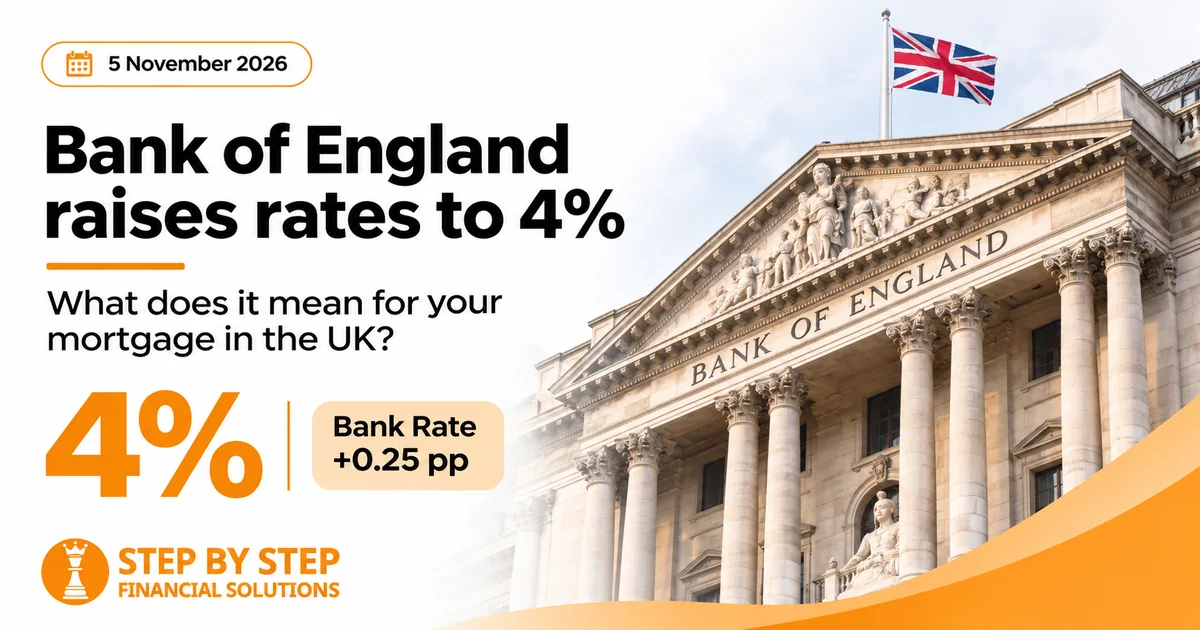
The Bank of England has raised the Base Rate (officially, Bank Rate) from 3.75% to 4%.
It is the first interest rate rise since August 2023, and the first change of any kind since the cut in December 2025.
For many homeowners, the first question is simple: will my mortgage go up?
The honest answer is that it depends on the type of mortgage you have. For most borrowers on a fixed rate, nothing changes today. For borrowers on a tracker or a Standard Variable Rate (SVR), the picture is different, and the timing depends on the lender.
In this article we explain what the decision means for fixed, tracker and SVR mortgages, when lenders are passing on the change, and what to do if you are thinking of switching from a tracker to a fix or your fixed rate mortgage is ending soon. Along the way, we show where a mortgage adviser can help you check your options.
The Bank of England interest rate decision: 4%, voted 8–1
At its meeting ending on 4 November 2026, the Monetary Policy Committee (MPC) voted by a majority of 8–1 to increase Bank Rate by 0.25 percentage points, to 4%. One member preferred a larger increase of 0.5 percentage points.
The main reason is inflation. UK CPI inflation rose to 3.5% in September, and the Bank of England now expects it to rise to around 5% by the middle of next year. Higher global energy prices, linked to the ongoing conflict in the Middle East, are the key driver.
The Bank said that monetary policy is "not on a pre-set path". Future decisions will depend on the incoming data and will be taken meeting by meeting.
The next MPC decisions are due on 17 December 2026 and 4 February 2027.
Will my mortgage go up after the interest rate rise?
According to UK Finance, around 87% of residential mortgages in the UK are on fixed rates. That means most borrowers will not see any immediate change to their monthly payments.
Here is how the main mortgage types are affected.
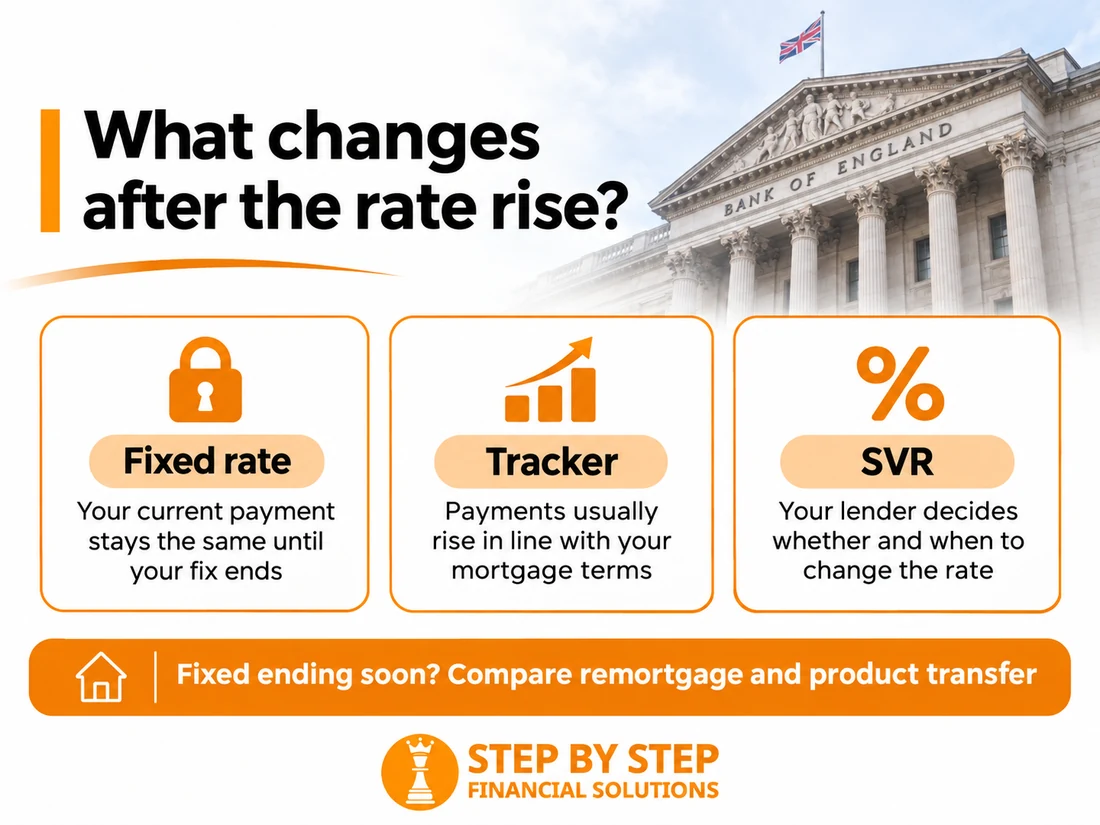
Fixed-rate mortgage
If you are on a fixed-rate deal, your interest rate and monthly payments stay the same until the end of your fixed period.
The rise matters later, when your deal ends and you choose a new product.
Tracker mortgage
A tracker mortgage follows an external rate, usually Bank Rate, plus a set margin. When Bank Rate rises by 0.25 percentage points, a tracker linked to it will normally rise by the same amount, in line with your mortgage terms.
How much your monthly payment goes up depends on your outstanding balance, your remaining term and the terms of your product. Your lender will tell you your new payment in writing before it changes.
Standard Variable Rate (SVR)
An SVR is set by your lender. It is not directly tied to Bank Rate, so the lender decides whether to change it, by how much and when.
Many lenders do pass on increases, but not always by exactly 0.25% and not always immediately. Some lenders have said their SVR is "under review".
If you have moved onto your lender's SVR because your previous deal ended, this is usually a good time to look at a product transfer or a remortgage (see below).
When will lenders pass on the rise?
Each lender sets its own timetable, and your lender should write to you before your monthly payment changes.
The table below only shows dates that lenders have confirmed on their official websites. Correct as at approx. 18:20 (UK time) on 5 November 2026. If your lender is not listed, it had not published a specific date on its website at that time – please rely on your lender's letter.
| Lender | Tracker linked to Bank Rate – change from | SVR / other variable rates |
|---|---|---|
| Nationwide | 1 December 2026 | SMR / BMR change from 1 December 2026 |
| The Mortgage Works (TMW) | 1 December 2026 | Managed rates – update "in due course" |
| Santander | 3 December 2026 | SVR change from 3 December 2026 |
| Coventry BS | 1 December 2026 | Under review |
| Yorkshire BS (YBS) | 29 November 2026* | Under review |
| Skipton BS | Rate change 19 November; payment change 1 December 2026** | Under review |
| HSBC | Within one day of the decision | Under review – not automatic |
| Newcastle BS | Within 14 days of the decision | Under review |
| Halifax | Usually from the 1st of the month after the decision (lender's general rule, no specific date) – confirm with your lender | No confirmed date – confirm with your lender |
* Yorkshire Building Society: YBS has said the monthly payment will not automatically change until March 2027 unless the customer asks for it to be recalculated. The interest rate still rises. On a standard repayment mortgage, this means that if your payment is not recalculated, your mortgage balance may reduce more slowly than you expect. If you are a YBS tracker customer, check your letter carefully.
** Skipton: these dates apply to trackers taken out with Skipton Building Society. Skipton gives different dates for mortgages originally from other brands – check your letter.
Always rely on the letter or notification from your own lender, as dates and terms can differ between product ranges. After the next MPC decision on 17 December 2026 we will add a clearly marked update to this article; the record of the 5 November decision will stay as it is.
Will fixed mortgage rates go up after the rate rise?
Not necessarily, and not automatically by 0.25%.
Fixed mortgage rates are priced mainly using swap rates, which reflect what financial markets expect interest rates to do in the future. This rise was widely expected, and the industry consensus is that it had already been "priced in" to swap rates weeks before the decision.
The Bank of England's own minutes note that benchmark two-year mortgage rates had already risen by nearly 0.5 percentage points since the beginning of September, while Bank Rate was still at 3.75%. Some high street lenders even cut selected fixed rates in the days before the announcement.
As reported by Mortgage Solutions, brokers expect that fixed rates should not jump immediately because of the decision itself.
In other words: Bank Rate and mortgage rates are not the same thing. We explained this in more detail in our September article, Base Rate Holds at 3.75%, but Mortgage Rates Are Rising.
Will interest rates rise again?
Nobody can say for certain, and we do not make interest rate forecasts.
The Bank of England says future decisions will be taken meeting by meeting and will depend on the incoming data, above all on inflation. There is no pre-set path.
Views across the mortgage industry differ. Some commentators expect further rises, while others think financial markets may be pricing in too much. That is exactly why it is difficult to make a mortgage decision based on predicting the next move.
Should you switch from a tracker to a fixed mortgage?
There is no single answer that suits everyone.
A fixed-rate mortgage gives certainty. Your payments stay the same for the fixed period, which can help with budgeting. However, fixed deals often come with early repayment charges (ERCs) if you leave early.
A tracker mortgage can sometimes start at a lower rate than a comparable fix and may offer more flexibility, as some trackers have no or lower early repayment charges. However, your payments will rise if Bank Rate rises.
As commentators quoted in What Mortgage pointed out, a tracker is generally only suitable for borrowers who could still afford their payments if rates went higher than expected.
If you are thinking of switching from a tracker to a fix, start by checking whether your current deal has an ERC and what fees the new product carries. The right choice depends on your budget, your plans for the property, how long you want certainty for, and the full cost of each option.
Fixed rate mortgage ending soon? Product transfer vs remortgage
If your current deal ends within the next six months or so, today's decision is a good prompt to start looking at your options, calmly and without rushing into the first offer you receive.
There are two main routes:
- Product transfer: switching to a new deal with your existing lender. It is often simpler, as there may be less paperwork and, in many cases, no new affordability assessment.
- Remortgage: moving your mortgage to a different lender. This may give access to a wider choice of products, but involves an application, affordability checks and potentially legal work.
The lowest headline rate is not always the best overall deal. Product fees, early repayment charges, the length of the deal and your future plans all matter.
Many lenders allow you to secure a new deal several months before your current one ends, which can help you avoid moving onto the SVR. Our guide Remortgage: how it works, when to do it and how to find a better rate explains the process step by step, and our remortgage calculator gives you a rough starting point.
What if you are buying a home?
For first-time buyers and home movers, the Base Rate headline is only part of the story.
Your mortgage options also depend on your income, deposit, existing commitments, credit history, mortgage term and the lender's criteria. A rise in Bank Rate can also affect affordability calculations, so it is worth checking where you stand before you make an offer. An Agreement in Principle (AIP) is a useful first step, and we do not charge for arranging one. Read more about first-time buyer mortgages and mortgages for home movers.
What does it mean for Buy to Let landlords?
Landlords on tracker or variable products will feel the change in the same way as residential borrowers.
Mortgage Solutions warned landlords that there is no reason to assume the rise in funding costs is over. Moneyfacts data quoted there shows that average Buy to Let fixed rates have risen noticeably since late February.
If your Buy to Let deal is ending, it may be worth reviewing rental income, lender stress tests (ICR), fees and ownership structure early. Read more about Buy to Let mortgages.
Base Rate at 4%: what should borrowers remember?
- If you are on a fixed rate, nothing changes until your deal ends.
- If you are on a tracker, your rate is likely to rise by 0.25%, with the timing depending on your lender.
- If you are on an SVR, your lender may raise it, but not necessarily by the same amount or straight away.
- New fixed rates do not automatically rise by 0.25%, as much of this rise was already priced in.
- If your deal ends within around six months, compare a product transfer and a remortgage, and do not leave it to the last minute.
You do not need to predict what the Bank of England will do next. What matters is understanding the options available in your situation today.
What does SBS charge?
| Service | SBS fee |
|---|---|
| Consultation (30 minutes, by phone) | Free |
| Purchase mortgage | Typically £395 |
| Remortgage | Typically £199 |
| Buy to Let | Typically £495 |
| Product transfer | No fee |
| Agreement in Principle (AIP) | No fee |
The precise amount depends on your circumstances. We will confirm your fee in writing before any chargeable activity begins.
Frequently Asked Questions (FAQ)
What does the Bank of England interest rate rise mean?
Bank Rate has gone up from 3.75% to 4%. Lenders usually pass this on to tracker mortgages and may raise their Standard Variable Rates. Savings rates can also rise. If you have a fixed-rate mortgage, your payments do not change until your deal ends.
Will my mortgage go up?
Only if you are on a tracker or variable rate. Trackers linked to Bank Rate will normally rise by 0.25%, from a date set by your lender. SVRs may rise at the lender's discretion. Fixed-rate payments stay the same until the fixed period ends.
When will my tracker mortgage go up?
It depends on the lender. Some, such as HSBC, apply the change within a day, while others, such as Nationwide and Coventry, apply it from 1 December 2026, and Santander from 3 December 2026. Your lender should write to you before your payment changes.
Can I switch from a tracker to a fixed mortgage?
Often, yes – through a product transfer with your current lender or a remortgage to a new one. Check first whether your tracker has an early repayment charge, and compare the full cost of the new deal, including fees.
What is an SVR mortgage?
A Standard Variable Rate (SVR) is a lender's default variable rate. Borrowers usually move onto it when a fixed, tracker or discounted deal ends. It is set by the lender, can change at any time and is often higher than other available deals.
My fixed rate mortgage is ending soon. When should I start looking?
Many lenders let you secure a new deal several months before your current one ends. Starting early gives you time to compare a product transfer with a remortgage without rushing, and can help you avoid moving onto your lender's SVR.
Should I fix my mortgage now or wait?
There is no universal answer. Waiting could help if rates fall, but rates could also move the other way. Many lenders let you secure a deal months in advance, so it is often worth reviewing your options early and deciding based on your own budget and plans rather than forecasts.
Product transfer vs remortgage: which is better?
It depends on your circumstances. A product transfer is usually simpler, while a remortgage may offer a wider choice. Fees, early repayment charges and your plans for the property should all be compared, not just the headline rate.
Disclaimer
This article is for information purposes only and does not constitute financial or legal advice. The content provides general information and should not be relied upon as professional guidance. It describes the Bank of England decision of 5 November 2026. Lender information reflects details published on lenders' websites as at approx. 18:20 (UK time) on 5 November 2026 and may change.
Risk Warnings
Your home may be repossessed if you do not keep up repayments on your mortgage.
You may have to pay an early repayment charge to your existing lender if you remortgage.
Buy to Let: Your property may be repossessed if you do not keep up repayments on your mortgage. Not all Buy to Let Mortgages are regulated by The Financial Conduct Authority.
There may be a fee for arranging a mortgage and the precise amount will depend on your circumstances i.e credit history, employment record. This will typically be £395 for purchases, remortgages £199 and we will not charge for a Product Transfer. We will provide you written confirmation of your fee prior to the commencement of any chargeable activity. For Buy to Let mortgages, the fee will typically be £495.
Step By Step Financial Solutions Ltd is an appointed representative of Stonebridge Mortgage Solutions Limited which is authorised and regulated by the Financial Conduct Authority. Registered Office: Step By Step Financial Solutions Ltd Unit 314, Solent Business Centre, 343 Millbrook Road West, Southampton, Hampshire, United Kingdom, SO15 0HW Registered Company Number: 08946989 registered in England & Wales. You can check the Financial Services Register at https://register.fca.org.uk/s/ our registration number is 780408.