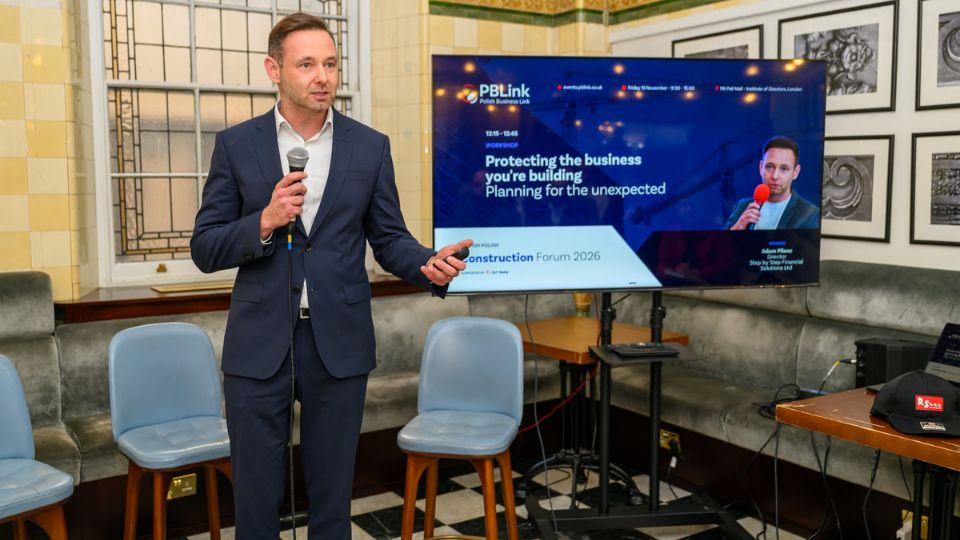
Adam Pilanc, Director, Step by Step Financial Solutions Ltd
At the British Polish Construction Forum in London on 13 November 2026, much of the conversation centred on growth: whether construction businesses should specialise or diversify, where to invest, how to retain good people and how to make better commercial decisions.
During my session, I wanted to focus on a different question:
What happens to the business if the person it depends on suddenly cannot work?
For many limited company directors, the business is much more than a source of income.
It represents years of work, employees, clients, commitments, family finances and future plans.
That is why business protection should not start with the question: “Which insurance policy should I buy?”
It should start with:
What am I trying to protect, and what would happen if I could not work for several months — or if I were no longer here?
Running a business always involves risk
Business growth is usually seen as a positive.
More clients. Higher turnover. More employees. Larger contracts. New services.
But growth does not automatically make a business more resilient.
Sometimes the opposite is true.
More projects can create more financial commitments. A larger team means a larger payroll. Growth can put additional pressure on cash flow.
Meanwhile, many small businesses still depend heavily on one or two people.
That makes one question particularly important:
How important are you to your business, and who else could it not operate without?
How many UK businesses survive their first five years?
The latest Office for National Statistics data shows that 37.6% of UK businesses born in 2020 were still trading five years later.
In other words, more than six in ten businesses from that cohort did not reach their fifth anniversary.
That does not mean they all closed for the same reason. Businesses cease trading for many different reasons.
But it demonstrates how difficult building a sustainable business can be.
Source: Office for National Statistics – Business demography, UK: 2025
Construction remains a particularly challenging sector
The construction industry faces its own pressures.
According to The Insolvency Service, 3,800 construction businesses entered formal insolvency in England and Wales during the 12 months to October 2026.
Construction accounted for 17% of insolvencies where an industry was recorded — the largest share of any sector.
That does not mean 17% of all construction companies became insolvent. It represents construction's share of recorded company insolvencies by industry.
Source: GOV.UK – Company Insolvency Statistics, October 2026
Why do businesses get into difficulty?
I divided the risks discussed during my BPCF presentation into three broad areas.
1. Financial survival
A business can look successful on paper.
It can have clients, a strong order book, growing turnover and even report a profit.
And yet it can still struggle to pay its bills.
Wages, VAT, suppliers, finance commitments and operating costs need to be paid regardless of when customers settle their invoices.
That is why cash flow can matter more to day-to-day survival than turnover alone.
Research commissioned by the Department for Business and Trade and the Office of the Small Business Commissioner illustrates the scale of the problem.
Late payments are estimated to cost the UK economy almost £11 billion each year, while around 14,000 businesses close annually because of late payment — the equivalent of 38 businesses every day.
UK businesses are also estimated to be owed around £26 billion in late payments at any given time.
Source: Office of the Small Business Commissioner – Late Payments Research
2. Commercial survival
A good product or service is not enough if the market does not need it or customers cannot find it.
Businesses can become vulnerable when they rely too heavily on a small number of clients, fail to invest in sales and marketing, struggle to differentiate themselves or react too slowly when customer behaviour changes.
Growth therefore needs to be tested commercially.
That links closely with one of the central questions at BPCF 2026: Niche or diversify?
PBLINK's article on Tomasz Goslar's experience building construction and recruitment businesses reaches a similar conclusion. New services should be tested against their commercial results, management capacity and genuine customer demand rather than assuming diversification is automatically a sign of progress.
Read more: PBLINK – Never Settle: Lessons on Building a Business in London
3. Management survival
Problems can also arise when a business grows faster than its systems.
No reliable financial forecast. Poor cost control. Hiring too quickly. Weak processes. Insufficient delegation. No plan for difficult months.
And one particularly important issue:
the business depends too heavily on its owner.
That is where business protection becomes relevant.
What if you are one of your company's most important assets?
In many small and owner-managed businesses, the director does much more than manage from a distance.
They win clients. They make key decisions. They oversee projects. They know suppliers. They manage relationships. They solve problems. They understand the finances.
If that person is unable to work for six or twelve months because of illness or injury, the consequences go far beyond their health.
- Who takes over their responsibilities?
- Can the company continue generating revenue?
- Can it continue paying the director?
- How would their household cope without the income normally coming from the company?
- What happens to the mortgage and other financial commitments?
- And if the owner dies, what financial position does that leave their family in?
These are not simply insurance questions. They are business continuity questions.
Business Protection is not one policy
Business Protection is a broad term for planning against the financial consequences of losing an owner, director or other key person through death, serious illness or long-term incapacity.
Depending on the company and the risk, solutions can include Relevant Life Plans, Executive Income Protection, Key Person Protection, Share Protection and Business Loan Protection.
Not every company needs every type of cover.
The starting point should therefore be the risk, not the product.
What is a Relevant Life Plan?
Relevant Life Plan for LTD Directors – SBS
A Relevant Life Plan, or RLP, is an individual life insurance policy taken out and funded by an employer for an employee, including an employed company director.
It can provide something similar to a death-in-service benefit for businesses that may be too small for a traditional group life scheme, including single-director companies where the director is also an employee.
The policy is normally written into an appropriate trust so that any benefit can be distributed to the intended beneficiaries in accordance with the trust.
A Relevant Life Plan can also offer tax advantages because the company funds the cover rather than the employee paying the premium from income that has already been taxed.
However, Corporation Tax relief should never be assumed automatically.
Tax treatment depends on the company's circumstances and whether the relevant HMRC requirements are met.
Step by Step Financial Solutions Ltd does not provide tax advice. Tax treatment should be confirmed with a qualified accountant or tax adviser.
Relevant Life Plan Calculator – SBS
Who can consider a Relevant Life Plan?
It may be suitable for employed limited company directors and key employees.
It is not suitable for everyone.
For example, a sole trader cannot arrange an RLP for themselves as their own employer.
Eligibility and product terms also vary between insurers.
What is Executive Income Protection?
Executive Income Protection – SBS
Executive Income Protection, or EIP, addresses a different risk.
Its purpose is to help a company continue providing income to an insured director or key employee if illness or injury prevents them from working for an extended period.
The company owns and pays for the policy.
Following a valid claim, the benefit is paid to the business. The company can then use that money to continue paying the insured person through payroll.
Depending on the insurer and policy, calculations may take account of salary, regular bonuses and certain dividends.
Some plans can also allow for additional employer costs.
The level of cover available, deferred period, benefit term and definition of incapacity all depend on the insurer, the policy and underwriting.
Executive Income Protection vs personal Income Protection
The main difference is who owns and funds the policy.
With personal Income Protection, the individual normally pays the premium from their own income.
With Executive Income Protection, the company funds the policy.
If an EIP claim is paid, the benefit first goes to the business. When the company then pays it to the insured employee or director as remuneration, the payment normally goes through payroll and the relevant Income Tax and National Insurance treatment applies.
For that reason, Executive Income Protection should not be described as providing a tax-free income.
Its potential advantages relate to the way the protection is funded by the company and, depending on the policy, the ability to reflect a director's wider remuneration structure.
Tax treatment will depend on individual circumstances.
Where should business protection planning start?
I would not begin by choosing an insurer.
I would begin with seven questions:
- What would happen if I could not work for the next six or twelve months?
- How long could the company continue without my active involvement?
- Could the business continue paying my income?
- Which people are genuinely critical to the company?
- What would happen to my family's finances if I died?
- What existing insurance or employee benefits are already in place?
- Does the protection I have still reflect the business and income I have today?
Only then can you identify whether there is a genuine protection gap and what type of solution might be appropriate.
Growing a business is not only about asking “How do we grow?”
At BPCF we discussed different routes to growth.
Should a business specialise or diversify? Hire or outsource? Buy equipment or hire it? How do you retain good people? How do you keep enough suitable work in the pipeline?
All of those questions matter.
I would add one more:
How do you protect what you have already built?
Because growth without resilience can simply create a bigger business with bigger commitments.
Protect the owner. Protect the business.
No insurance policy can remove every risk of running a company.
It cannot prevent a bad contract, the loss of a major customer or a change in the market.
But a business can plan for one very important scenario:
What happens if the owner or another key person can no longer work?
If you run a limited company in the UK and do not know what would happen to your income, your business and your family in that situation, it may be worth finding out before the contingency plan is needed.
Important information
This article is for general information only and does not constitute personalised financial, tax or legal advice.
The appropriate type and level of cover depend on individual circumstances, company structure, remuneration, occupation, health, insurer criteria and underwriting.
Tax treatment depends on individual circumstances and HMRC rules and may change. Step by Step Financial Solutions Ltd does not provide tax advice. You should seek advice from a suitably qualified accountant or tax adviser where appropriate.
As with all insurance policies, conditions and exclusions will apply.
Step By Step Financial Solutions Ltd is an Appointed Representative of Stonebridge Mortgage Solutions Ltd, which is authorised and regulated by the Financial Conduct Authority.
FCA register number: 780408.
Sources
- Office for National Statistics, Business demography, UK: 2025
- The Insolvency Service, Company Insolvency Statistics, October 2026
- Office of the Small Business Commissioner, Late Payments Research
- PBLINK, Never Settle: Lessons on Building a Business in London
- British Polish Construction Forum 2026 – event information