
To get a buy-to-let mortgage in the UK, you will typically need a deposit of around 25%, a property suitable for letting and sufficient expected rental income to meet the lender’s affordability requirements. Many lenders require rent to cover between 125% and 145% of mortgage interest calculated at an assessed interest rate. Exact requirements depend on the lender, product, property and your financial circumstances.
Whether you are buying your first rental property, expanding a portfolio or investing through a limited company, understanding these requirements can help you prepare before making an offer.
Key facts about buy-to-let mortgages
A 25% deposit is a common starting point.
Expected rental income plays a central role in mortgage affordability.
Interest-only mortgages are common, but the outstanding capital must still be repaid.
Some lenders have minimum personal income requirements.
Purchase taxes, running costs and landlord responsibilities should form part of your budget.
Personal and limited company ownership have different mortgage and tax implications.
What is a buy-to-let mortgage?
A buy-to-let (BTL) mortgage finances a property you intend to rent out rather than live in yourself. Unlike residential lending, which primarily assesses personal income and expenditure, BTL lending focuses heavily on expected rental income. Lenders may also consider personal income, credit history, financial commitments and landlord experience.
Buy-to-let vs residential vs let-to-buy mortgages
| Feature | Residential | Buy-to-let | Let-to-buy |
|---|---|---|---|
| Purpose | Home to live in | Rental property | Let existing home and buy another |
| Affordability | Personal income and expenditure | Rent and borrower circumstances | Rental and residential affordability |
| Deposit or equity | Often from 5%, subject to eligibility | Typically around 25% or more | Equity in existing property and deposit for new home |
| Repayment | Capital repayment common | Interest-only or repayment | Depends on each mortgage |
If you already have a residential mortgage and want to rent out your home, speak to your lender about consent to let or switching to a suitable BTL mortgage before accepting tenants. Letting without the required permission could breach your mortgage conditions.
How much deposit do you need for a buy-to-let mortgage?
Most prospective landlords should budget for around 25% of the purchase price. This represents a 75% loan-to-value (LTV) mortgage. LTV describes the proportion of the property’s value financed by the mortgage.
| Property price | Deposit at 25% | Mortgage amount |
|---|---|---|
| £150,000 | £37,500 | £112,500 |
| £200,000 | £50,000 | £150,000 |
| £250,000 | £62,500 | £187,500 |
| £300,000 | £75,000 | £225,000 |
These figures are illustrative. Actual borrowing depends on lender criteria, rental affordability and valuation.
Can you get a buy-to-let mortgage with a 20% deposit?
Some lenders may offer mortgages at 80% LTV. Availability can be more limited and products may have higher rates, different fees or more demanding eligibility requirements. A larger deposit may improve your options, but retain sufficient funds for purchase costs, repairs and periods without rental income. Certain flats, HMOs and other specialist properties may have different deposit requirements.
How much rental income do you need for a buy-to-let mortgage?
Lenders commonly use an Interest Coverage Ratio (ICR) to assess whether expected rental income supports the mortgage. The ICR compares expected rent with mortgage interest calculated at the lender’s assessment rate. Many lenders use an ICR between 125% and 145%, although other thresholds may apply depending on the product, ownership structure and borrower.
Buy-to-let rental affordability example
| Item | Amount |
|---|---|
| Property price | £200,000 |
| Deposit | £50,000 |
| Mortgage | £150,000 |
| LTV | 75% |
| Illustrative stress rate | 5.5% |
| Assessed monthly interest | £687.50 |
| Required monthly rent at 125% ICR | £859.38 |
| Required monthly rent at 145% ICR | £996.88 |
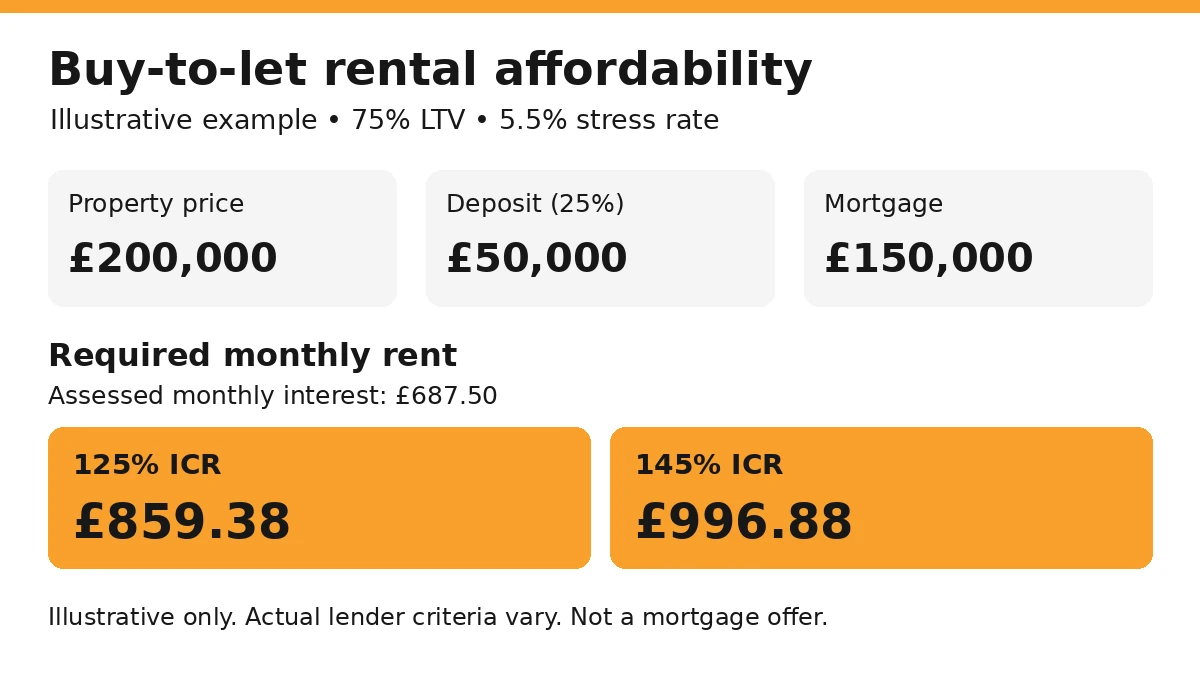
The same property could meet one lender’s rental affordability requirements but fall short of another’s. These calculations are illustrative; the stress rate is not an advertised mortgage rate and the figures do not represent an offer or guarantee of borrowing.
Why do lenders stress-test buy-to-let mortgages?
A lender may assess a mortgage using a rate higher than the initial rate you would actually pay. This helps assess whether rental income could support the loan if borrowing costs increase. Assessment varies by product, fixed-rate period, lender and ownership structure. The lowest initial rate does not necessarily allow you to borrow the most. See the Bank of England’s buy-to-let underwriting standards.
What if the rental income is not high enough?
Some lenders use top-slicing, where eligible personal income is considered alongside rent to support affordability. Depending on the lender, this may include employment, self-employed or pension income, or surplus rental income from other properties. Top-slicing is not universally available and may involve extra checks. Consider whether the investment remains sustainable if you need to use your own income to cover a shortfall.
Interest-only or repayment buy-to-let mortgages
Interest-only mortgages are common among landlords because monthly payments cover interest rather than reducing the original loan balance. This can leave more rent available for other property expenses. Unless you make capital repayments, the full outstanding balance must be repaid at the end of the term.
A repayment strategy could involve selling the property, using savings or refinancing, subject to future eligibility. Refinancing is not guaranteed, and a fall in property value could make it more difficult to repay the mortgage through a sale. With capital repayment, monthly payments include interest and part of the loan. Payments are generally higher, but the balance reduces over time if payments are maintained. The appropriate structure depends on your circumstances, investment plans and ability to manage risk.
What are the costs of buying a rental property in the UK?
Upfront costs
Budget separately for mortgage product and advice fees, valuation and survey fees, legal fees, property purchase taxes, initial repairs, furnishing, safety checks and landlord insurance. A mortgage with a lower rate but a substantial arrangement fee may not provide the lowest overall cost.
Stamp Duty and property purchase taxes across the UK
Purchase tax depends on property location, existing ownership and how you buy.
| Location | Tax | Additional property rules |
|---|---|---|
| England | SDLT | Additional 5 percentage points generally apply where higher-rate conditions are met |
| Northern Ireland | SDLT | Same higher-rate system as England |
| Scotland | LBTT | 8% Additional Dwelling Supplement may apply |
| Wales | LTT | Separate higher residential rates apply where relevant |
A buy-to-let purchase does not automatically mean an individual buyer pays additional property rates. Existing ownership, company ownership and other circumstances matter. First-time buyer relief, where available, generally requires purchase as your main home rather than solely as an investment. Non-UK residents may also face additional SDLT charges in England or Northern Ireland.
Check official guidance: SDLT residential rates, Scotland ADS and Wales LTT rates.
Ongoing landlord costs
Rental income must cover more than mortgage payments. Typical expenses include maintenance, repairs, insurance, letting agent fees, safety inspections and, where relevant, service charges and licensing fees. Budget for void periods when the property is empty or rent is interrupted. Mortgage payments and certain expenses continue even without rental income.
How do you calculate whether a buy-to-let property is profitable?
Mortgage affordability and investment profitability are different calculations. A property can meet a lender’s affordability requirements but generate a low or negative return after costs and tax.
Gross rental yield
Gross rental yield = annual rental income ÷ purchase price × 100.
A £200,000 property generating £1,100 per month produces annual rent of £13,200 and a gross yield of 6.6%. Gross yield excludes mortgage interest, maintenance, insurance, tax and other costs.
Monthly cash flow example
Using the same property and a £150,000 interest-only mortgage:
| Monthly income or expense | Amount |
|---|---|
| Rental income | £1,100 |
| Mortgage interest at assumed 5% | −£625 |
| Maintenance and other operating costs | −£150 |
| Allowance for void periods | −£75 |
| Estimated cash flow before tax | £250 |
Actual expenses could be considerably higher and purchase costs are excluded. A repayment mortgage would also require capital repayments. The assumed rate is illustrative, not an available product quote. Assess financial performance separately from lender affordability.
Should you buy personally or through a limited company?
Properties can be purchased in your own name or through a limited company, subject to mortgage eligibility. Many company landlords use a Special Purpose Vehicle (SPV), established primarily for property investment.
| Consideration | Personal ownership | Limited company |
|---|---|---|
| Borrower | Individual | Company |
| Rental profit tax | Generally Income Tax | Generally Corporation Tax |
| Finance costs | Residential finance cost restrictions generally apply | May generally be deductible, subject to tax rules |
| Administration | Personal property income reporting | Company accounts, tax returns and reporting |
| Mortgage products | Personal BTL | Specialist company BTL |
| Personal guarantees | Not normally applicable in the same way | Frequently required |
Mortgage interest tax relief for individual landlords
For 2026/27, individual residential landlords are generally unable to deduct mortgage interest directly from rental profits for Income Tax. Qualifying finance costs may instead give rise to a 20% tax reduction, subject to applicable restrictions and calculation limits. This can affect profitability, particularly for higher-rate taxpayers. Check the rules applying to future tax years and consider potential Capital Gains Tax on disposal. See HMRC guidance on residential landlord tax relief.
Limited company buy-to-let mortgages
Company ownership does not automatically make an investment more profitable. Mortgage pricing, company administration costs, Corporation Tax and tax on withdrawing profits all matter. Lenders may require an appropriate company structure, acceptable SIC codes and personal guarantees. SBS can help you explore limited company mortgage options. Consult an accountant or qualified tax adviser before selecting your ownership structure.
Who can get a buy-to-let mortgage?
First-time buyers and first-time landlords
Some lenders accept applicants who have never owned a property; others require an existing homeowner or landlord. Options may be more limited if your first purchase is a rental investment. Consider the effect on future first-time buyer schemes or tax relief.
Self-employed applicants and company directors
Self-employment does not automatically prevent you obtaining a BTL mortgage. Some lenders require minimum personal income; others focus more heavily on rent and wider circumstances. Depending on your business structure and lender, you may need accounts, tax calculations, tax year overviews or bank statements. Company directors may need evidence of salary, dividends or other accepted income.
Foreign nationals and UK expats
Foreign nationals living in the UK and British expats living overseas may be eligible. Options depend on residency, immigration status where relevant, country of residence, income currency, credit history and deposit. Overseas applicants may require specialist expat or non-resident products.
Portfolio landlords
If you have four or more mortgaged buy-to-let properties, lenders applying the PRA portfolio landlord framework may use specialist underwriting requirements, reviewing existing properties, outstanding mortgages, rent, overall portfolio affordability and investment plans. Requirements vary by lender.
What landlord responsibilities should you consider before buying?
Legal responsibilities may include gas and electrical safety, EPC requirements, tenancy deposit protection, maintenance, registration or licensing and compliance with tenancy legislation. Rules differ across England, Wales, Scotland and Northern Ireland. Landlords in England should familiarise themselves with applicable provisions of the Renters’ Rights Act and implementation dates. See government landlord responsibilities guidance and Renters’ Rights Act guidance.
How to apply for a buy-to-let mortgage: step by step
Step 1: Review your budget and investment plans
Work out your deposit, purchase costs, expected rent and reserves. Discuss any proposed company structure with an accountant.
Step 2: Prepare your documents
You may need identity and address evidence, bank statements, deposit and source-of-funds evidence, existing mortgage and debt details, and income evidence where required. Self-employed applicants, directors and portfolio landlords may need additional documents.
Step 3: Obtain an Agreement in Principle
An AIP can indicate how much a lender may be prepared to lend on the available information. It is not an offer or guarantee of approval.
Step 4: Find a suitable rental property
Consider price, local rental demand, expected market rent, condition and ongoing costs. Not every property meets lender criteria.
Step 5: Submit the full application
Once an offer has been accepted, submit the mortgage application and supporting documents.
Step 6: Valuation and underwriting
The lender assesses property value, expected rent and your application. Further evidence may be requested. A mortgage valuation is not a substitute for an independent condition survey.
Step 7: Receive your mortgage offer
If approved, the lender issues a formal offer. Your solicitor or conveyancer completes legal checks and reviews mortgage conditions.
Step 8: Complete the purchase
Once mortgage and legal requirements are satisfied, completion or settlement can proceed. Before letting, ensure relevant insurance, safety, licensing and tenancy requirements are in place.
How to compare buy-to-let mortgage deals
Compare overall costs during the initial period, fees, rental affordability requirements, early repayment charges and what happens when the initial deal ends. Criteria vary significantly for limited companies, self-employed applicants, first-time landlords, portfolio landlords and specialist properties. Mortgage advice can help you compare available options and understand which lenders may consider your circumstances. Some direct-only deals may not be available through intermediaries.
Frequently asked questions
Can I live in a property with a buy-to-let mortgage?
Standard BTL mortgages generally finance properties rented to tenants rather than occupied by the borrower or close family. Discuss family occupation with an adviser.
Do I need to earn £25,000 a year?
Not necessarily. Some lenders require £25,000 or another minimum; others apply different criteria. Eligibility depends on the lender, rent and circumstances.
Can I get a buy-to-let mortgage if I already have a residential mortgage?
Yes, subject to eligibility. Lenders may consider existing mortgages, commitments and rental affordability.
Can I buy a property with tenants already living in it?
Some lenders accept existing tenants, subject to tenancy arrangements, property condition, legal documentation and lender requirements.
Can I get a buy-to-let mortgage as a first-time buyer?
Some lenders accept first-time buyers purchasing rental properties, although options may be limited. You do not always need to own a home before becoming a landlord.
Is a buy-to-let mortgage regulated by the FCA?
Most business-purpose buy-to-let mortgages are not regulated by the FCA in the same way as residential mortgages. Consumer buy-to-let and certain other arrangements may fall within different regulatory frameworks.
Related guidance
You may also find these SBS Finance pages useful:
Get buy-to-let mortgage advice from SBS
At Step by Step Financial Solutions, we help clients across the UK explore mortgage options for rental properties, from first-time landlord purchases to limited company and portfolio investments. Our advisers can help you understand borrowing options, rental income requirements, deposit needs and product costs. We provide advice in English and Polish.
Whether you have found a property or are working out your investment budget, start with a free 30-minute consultation. A mortgage advice fee may apply if you decide to proceed; the applicable fee will be confirmed before chargeable work begins.
Important information
This article provides general information and does not constitute personalised mortgage, investment, legal or tax advice. Products and lending criteria are subject to change. Applications are subject to eligibility, affordability, valuation and lender approval. Tax treatment depends on individual circumstances and may change.
Your property may be repossessed if you do not keep up repayments on your mortgage.
The Financial Conduct Authority does not regulate most buy-to-let mortgages.
Step by Step Financial Solutions Ltd is an appointed representative of Stonebridge Mortgage Solutions Limited, which is authorised and regulated by the Financial Conduct Authority. Financial Services Register reference number: 780408.